|
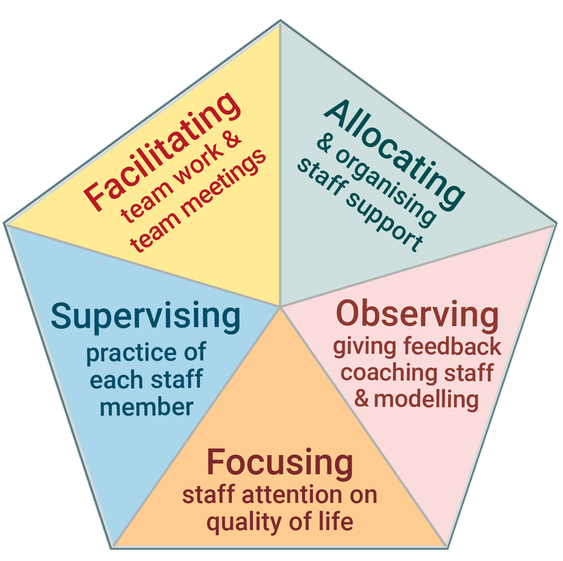
Frontline Practice Leadership is the set of five tasks that are critical to ensuring good quality support for people with intellectual disabilities.
The five tasks of Frontline Practice Leadership are shown in the diagram. |
In the following video, we take a closer look at the five tasks of Practice Leadership.
Why is Frontline Practice Leadership Important?
|
Frontline Practice Leadership is important because it is a practical way of supporting staff to develop their skills and improve how they provide direct support to people with intellectual disabilities. |
Each day, support workers directly influence the quality of life of the people they support. What support workers do and how they do it matters to the lives of people with intellectual disabilities.
Support workers - like staff in any organisation - need guidance, instruction and support to develop their skills and become competent. It is the role of Frontline Practice Leaders to help support workers to develop and enhance their skills.
Strong Frontline Practice Leadership ensures staff provide good Active Support. If support workers provide good Active Support, then people with intellectual disabilities will experience a better quality of life.
Active Support is a practice designed to increase the engagement of people with intellectual disabilities in meaningful activities and social interactions. We know from research that training staff in Active Support is often not enough for it to be successfully implemented and maintained in services. By using Practice Leadership you can embed Active Support in services.
You can read more about Active Support at the Every Moment Has Potential website. Links to research about Practice Leadership and Active Support are provided in the Resources section.
Who is responsible for the tasks of Practice Leadership?
Staff responsible for the five tasks of Practice Leadership are not always called Practice Leaders. Organisations have different titles for staff who do these tasks, such as:
Usually, it is the direct supervisor of support workers in a service who is responsible for the five tasks of Practice Leadership. A supervisor may be responsible for one service, or across two or three services.
There is no one way of organising Practice Leadership. In some organisations, the tasks of Practice Leadership are divided between different staff. For example, a team leader is responsible for individual staff supervision and team meetings in a service, and a senior support worker is responsible for coaching staff and modelling good practice in that service.
It is important that:
In the following video, three Frontline Practice Leaders talk about their role and responsibilities.
- Supervisor
- Frontline manager
- Team leader
- Service manager
Usually, it is the direct supervisor of support workers in a service who is responsible for the five tasks of Practice Leadership. A supervisor may be responsible for one service, or across two or three services.
There is no one way of organising Practice Leadership. In some organisations, the tasks of Practice Leadership are divided between different staff. For example, a team leader is responsible for individual staff supervision and team meetings in a service, and a senior support worker is responsible for coaching staff and modelling good practice in that service.
It is important that:
- Whoever does the five tasks of Practice Leadership is close to the front line and knows the staff and the people they support well
- Organisations provide sufficient time for the five tasks to be done well
- Where the tasks of Practice Leadership are split between different staff they work together to share information and coordinate their work
In the following video, three Frontline Practice Leaders talk about their role and responsibilities.

|
Activity |
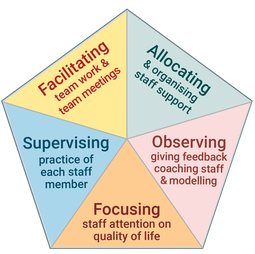
Look at the five tasks of Practice Leadership in the diagram. Think about where you work:
|
|
Summary
Frontline Practice Leadership involves influencing service delivery and staff practices so that people with intellectual disabilities experience good quality of life. It consists of five tasks, which are the focus of this training resource.
In the next module, we look at the first task of focusing staff attention on quality of life.
In the next module, we look at the first task of focusing staff attention on quality of life.